


“Dynastic” Egypt—sometimes referred to as “Pharaonic”—was the time when the country was largely unified under a single ruler, starting around 3100 B.C.E. The period before this, lasting from about 5000 B.C.E. until unification, is referred to as Predynastic by modern scholars.

Viewed as a golden age by later Egyptians, the Old Kingdom was a period of great confidence, stability, organization, and administrative control. Exemplified by the soaring pyramids and royal representations that project a remarkable level of poise and serenity, this period demonstrates the stability and wealth that resulted from the success of the storehouse-based economic system. The kings devoted huge resources to provisioning their mortuary cults via state run building projects. Power was delegated to elite overseers who administered these massive endeavors, earning royal ‘endowments’ for their own afterlife in the process. Labor, both highly-skilled and untrained, was derived from the native population (mostly during the flooding season, when fields could not be worked) and there is archeological evidence that they were fairly compensated.
Viewed as a golden age by later Egyptians, the Old Kingdom was a period of great confidence, stability, organization, and administrative control. Exemplified by the soaring pyramids and royal representations that project a remarkable level of poise and serenity, this period demonstrates the stability and wealth that resulted from the success of the storehouse-based economic system. The kings devoted huge resources to provisioning their mortuary cults via state run building projects. Power was delegated to elite overseers who administered these massive endeavors, earning royal ‘endowments’ for their own afterlife in the process. Labor, both highly-skilled and untrained, was derived from the native population (mostly during the flooding season, when fields could not be worked) and there is archeological evidence that they were fairly compensated.
Light-colored pots like this one, made of marl clay mined from desert wadis and painted with red ochre pigment, are known as Decorated ware. They are characteristic of later Predynastic times (c. 3500–3200 B.C.E.). The most intriguing are those painted with boats and human figures. This pot comes from the tomb of a young woman, at el-Amra in Middle Egypt, but pots showing boats have been found throughout Egypt and into Nubia. The boats are always strikingly similar, with a curved hull, a large number of oars, and two cabins in the center. Attached to one of the cabins (usually the right-side one) is a pole bearing an emblem, which may be the symbol of a god or a place.
This ivory plaque is a label. The sandals incised on the back indicate that it was originally attached to a pair belonging to Den, the fifth king of the First Dynasty.
Some artifacts are of such vital importance to our understanding of ancient cultures that they are truly unique and utterly irreplaceable. The gold mask of Tutankhamun was allowed to leave Egypt for display overseas; the Narmer Palette, on the other hand, is so valuable that it has never been permitted to leave the country.
Discovered among a group of sacred implements ritually buried in a deposit within an early temple of the falcon god Horus at the site of Hierakonpolis (a capital of Egypt during the Predynastic period), this large ceremonial object is one of the most important artifacts from the dawn of Egyptian civilization. The beautifully carved palette, 63.5 cm (more than 2 feet) in height and made of smooth greyish-green siltstone, is decorated on both faces with detailed low relief. These scenes show a king, identified by name as Narmer, and a series of ambiguous scenes that have been difficult to interpret and have resulted in a number of theories regarding their meaning.
The high quality of the workmanship, its original function as a ritual item dedicated to a god, and the complexity of the imagery clearly indicate that this was a significant object, but a satisfactory interpretation of the scenes has been elusive.
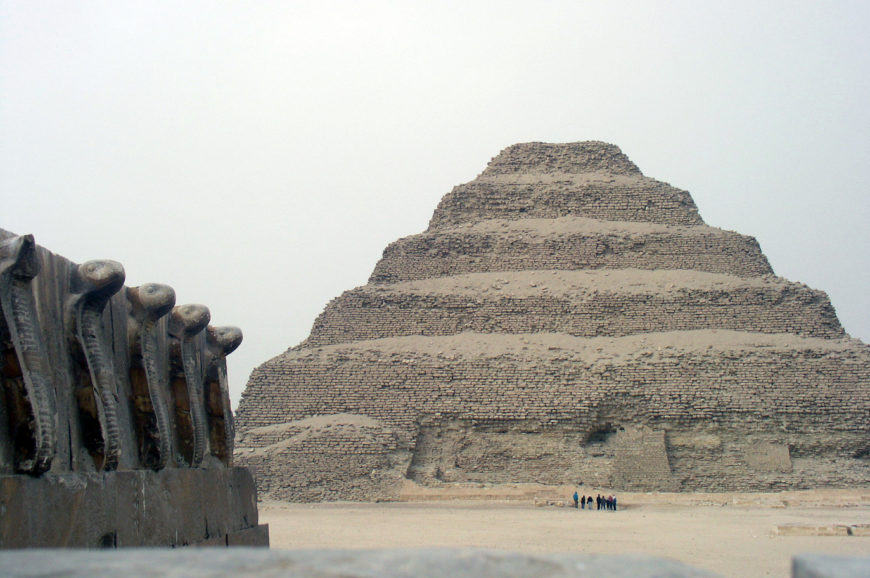
Pyramid building in ancient Egypt had its “big bang” at Saqqara in the 3rd Dynasty with a genius named Imhotep, who served as chancellor to king Netjeryknet, better known as Djoser. Djoser not only placed his mortuary complex (which was intended for the king’s ka (spirit) to use in the afterlife) at the site of Saqqara—a different location from his predecessors—but the complex he developed with Imhotep would impact all royal memorial monuments made after his. While the complex had many innovations, among the most important are that it was the first mortuary structure in stone, the first stepped pyramid instead of a single mastaba (a flat, rectangular tomb form), and the first to combine both mortuary and ritual buildings, and to pair functional buildings with dummy ones that couldn’t actually be used.
The last remaining of the Seven Wonders of the ancient world, the great pyramids of Giza, are perhaps the most famous and discussed structures in history. These massive monuments were unsurpassed in height for thousands of years after their construction and continue to amaze and enthrall us with their overwhelming mass and seemingly impossible perfection. Their exacting orientation and mind-boggling construction has elicited many theories about their origins, including unsupported suggestions that they had extra-terrestrial impetus. However, by examining the several hundred years prior to their emergence on the Giza plateau, it becomes clear that these incredible structures were the result of many experiments, some more successful than others, and represent an apogee in line with the development of the royal mortuary complex.
The Great Pyramid, the largest of the three main pyramids at Giza, was built by Khufu and rises to a height of 146 meters (481 feet). Humans constructed nothing taller than the Great Pyramid until 1221 C.E., when the steeple of Old St. Paul’s Cathedral was built in London and, at 149 meters (489 feet), surpassed it—at least until the steeple collapsed less than 350 years later.
The second great pyramid of Giza was built by Khufu’s second son Khafre. At the very top, a section of outer casing stones like those that would have originally covered all three of the Great Pyramids still survives. Although this monument appears larger than that of his father, it is actually slightly smaller but was constructed 10 meters (33 feet) higher on the plateau.
The third of the major pyramids at Giza belongs to Menkaure. This is the smallest of the three, rising to a height of 65 meters (213 feet), but the complex preserved some of the most stunning examples of sculpture to survive from all of Egyptian history.
Serene ethereal beauty, raw royal power, and evidence of artistic virtuosity have rarely been simultaneously captured as well as in this breathtaking, nearly life-size statue of the pharaoh Menkaure and a queen from c. 2490–2472 B.C.E. Smooth as silk, the meticulously finished surface of the dark stone captures the physical ideals of the time and creates a sense of eternity and immortality even today.
Seated cross-legged, with rolls of belly fat, this painted statue differs from the ideal statues of pharaohs.
Tjeti must have been both important and wealthy to have commissioned this statue. While wooden tomb statues are usually carved in a manner that is almost crude, the sculptor of this example has carefully modeled the muscles on the torso and legs, and paid close attention to the detail of the face. Fine wood was scarce and expensive in Egypt so the statue was not carved from a single block. Instead, the arms were made separately and pegged onto the body which in turn was set into a separate base. The figure was once fully painted, and the eyes are inlaid with white limestone and obsidian set in copper frames.
Egyptian sculpture is often thought to consist only of massive and regal statues of the kings of Egypt. However, there exist also more intimate images, so-called ‘private’ sculptures, made to be placed in the tombs of non-royal officials. The earliest date to the Third Dynasty (about 2686–2613 B.C.E.).