
Throughout history, there have been many great patrons who, whether out of passion or investment
, have taken it upon themselves to raise art to a higher level.
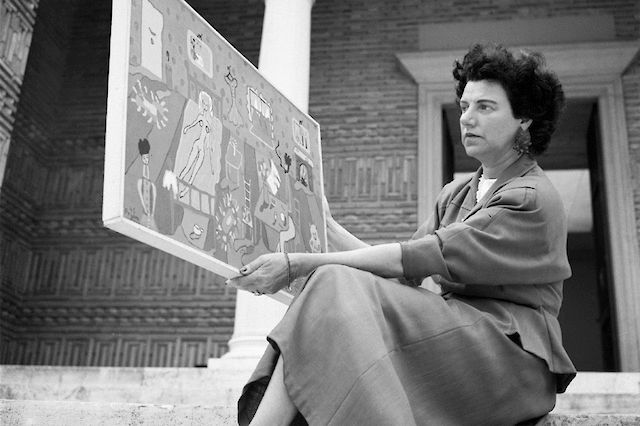
New Yorker Peggy Guggenheim was not only an art collector but also a true pioneer.
She shaped the cultural landscape of the 20th century, encouraging the emergence of new avant-garde movements and, with
her eclectic taste and audacity, created one of the most important art collections in the world.
Her name is linked not only to masterpieces of modern art, but also to a radical approach to
collecting, guided more by instinct than by consensus.
The origins of a passion
Born in New York in 1898, Marguerite Guggenheim, better known as Peggy, came from
a family already immersed in the world of art and patronage. Her father, Benjamin
Guggenheim, was a mining magnate who tragically died in the sinking of the
Titanic.
But it was her uncle Solomon R. Guggenheim,
who laid the foundations for the family's cultural legacy by founding the renowned Solomon R. Guggenheim Foundation in 1937 and subsequently opening the
museum that bears his name in New York.
Despite this, Peggy decided to follow her own independent and unconventional path,
determined to write her own chapter in art history.
The European years and rise as a patron
In 1921, Peggy moved to Europe, where she came into contact with the avant-garde art circles
in Paris and London. It was during this period that she began collecting works by emerging artists
such as Marcel Duchamp, Max Ernst (who also became her husband for a short period), Salvador
Dalí, and many others.
In 1938, she opened her first gallery in London, the Guggenheim Jeune, where she exhibited artists who were little known at the time, such as Henry Moore and Wassily Kandinsky. However, her most ambitious project was to open a museum dedicated to contemporary art.
The project was interrupted before it even began with the outbreak of World War II. Peggy was forced to leave Europe and return to New York to find refuge. Despite everything, she did not stop: during the war, she set herself the goal of buying one painting a day. Thanks to this decision, her collection now includes works by Picasso, Francis Picabia, Piet Mondrian, and many others. In 1942, she opened the "Art of This Century" museum gallery in New York, where she exhibited surrealist, abstract, and cubist works from her collection. She also offered exhibitions to emerging artists, such as
Pollock's first solo exhibition in 1943, and created several collectives of female artists.
The Venetian turning point
In 1947, after the war, Peggy returned to Europe and chose Venice as her permanent home
. The lagoon city, with its history and unique charm, became the perfect stage
for her innovative spirit.
She purchased Palazzo Venier dei Leoni on the Grand Canal, an unfinished 18th-century building that
became not only her residence but also the home of her extraordinary collection.
In 1948, her collection was exhibited at the Venice Biennale in the Greek pavilion,
arousing great interest as it was the first time that works by Pollock and
Rothko had been seen in Europe, consolidating her role as an international patron of the arts.
In 1951, she began to open her home to the public and in 1962 she was awarded honorary citizenship
by the city of Venice.
The Peggy Guggenheim Collection in Venice now houses around 200 works and is one of the most visited museums in Italy
and a must-see for lovers of modern art.
A journey through the European avant-garde
One of the most significant parts of the collection is represented by Cubist works.
Among these, Pablo Picasso's "The Poet" (1911) stands out, a work that shows the evolution of the
Cubist language in the analysis of forms and their geometric decomposition.
Another fundamental work is Juan Gris's "Bottle of Rum and Newspaper" (1914), where the treatment
of surfaces and the arrangement of objects evoke the typical cubist synthesis.
Among the abstract artists, Piet Mondrian is represented with "
" (1938-39), a work that embodies the rigor and harmony of neoplasticism.
Jackson Pollock occupies a place of honor. Peggy was one of the first to believe in his talent,
purchasing numerous works and even commissioning him to create pieces for her home.
Among the masterpieces on display, "Alchemy" (1947) stands out, a canvas where Pollock experiments with the dripping technique, applying colors and materials directly onto the canvas with spontaneous and dynamic gestures.
Other exponents of Abstract Expressionism in the collection are Mark Rothko and Clyfford Still, both represented by works that enhance the color and emotional depth of painting.
But it's not just abstract art: Surrealism, one of Peggy's favorite movements, occupies a central place in the collection.
Among the prominent artists is Salvador Dalí with "Birth of Liquid Desires" (1931), a painting that explores the subconscious through dreamlike images laden with symbolism.
Another iconic work
is "The Dressing of the Bride" by Max Ernst (1940), a painting that Peggy purchased for its
personal significance, as Ernst was her partner for several years. This surreal canvas, rich in
enigmatic details and hybrid figures, reflects the artist's complex imagination.
René Magritte could not be left out, and Peggy owns his "L'empire des lumières" (1954), a work
that plays with light and darkness, creating a suspended and mysterious atmosphere.
Peggy's collection is not limited to painting, but also includes important sculptures.
mong these, Alexander Calder's imposing steel "cow" stands out, a kinetic work that plays with
movement and the lightness of materials. Alberto Giacometti is present with his threadlike
and disturbing figures, such as "Walking Woman" from 1936, an iconic plaster sculpture that explores the
human condition and loneliness.
A timeless legacy
Peggy Guggenheim's collection is not just a collection of artworks, but a manifesto of
her taste and personality. Each work tells a story, an encounter, a discovery. Peggy
was able to see beyond her time, supporting artists who changed the history of art and
leaving a legacy that continues to inspire generations of enthusiasts and scholars.
The Palazzo Venier dei Leoni is not just a museum, but a place where past and present
meet. With its rooms and sculpture garden, art continues to live and dialogue with
visitors, just as Peggy wanted.

Join in!
Comments