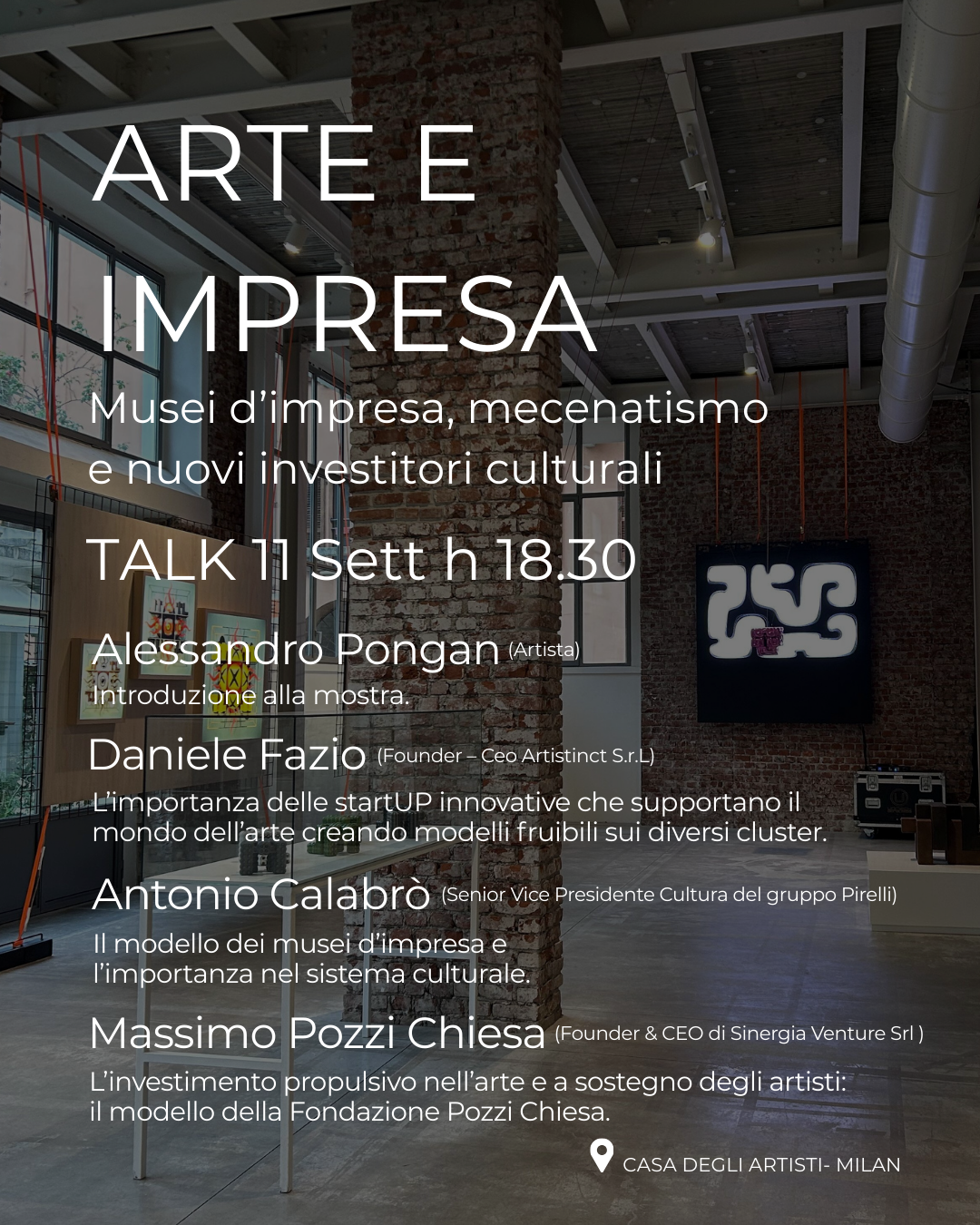
The future of art increasingly involves new forms of collaboration between creativity and business. This was demonstrated by the talk "Art and Business," held yesterday at Casa degli Artisti in Milan, a crossroads of contemporary creativity and symbol of its interdisciplinary vocation.
In the welcoming Milanese space that has been a reference point for contemporary artistic research for decades, we witnessed one of those debates that leave their mark. The talk "Art and Business," moderated with her usual skill by Susanna Ravelli, brought together protagonists from seemingly distant worlds: artists, entrepreneurs, investors, and representatives of foundations, but united by one certainty: patronage can no longer be limited to a philanthropic gesture. Today, it has become a strategic lever, capable of producing cultural, social, and economic value.
The courage to reinvent oneself
The first to speak is artist Alessandro Pongan, and the audience immediately pays close attention. He is not just an artist presenting his exhibition, but a witness to a journey that speaks to many. "Entering the world of art after almost fifty years in design and industrial communication was difficult," he confesses without rhetoric. His disarming sincerity strikes the audience like an electric shock.
In the room, there are those who suddenly seem aware that artistic paths no longer follow the linear trajectories of the past. The works in the exhibition "TOTEM – Ex Voto," which provide the backdrop for the meeting, speak for themselves: rigorous geometries combined with poetic imagination, spirituality meeting technology. It is tangible proof that industrial experience, far from being an obstacle, can fuel new and surprising artistic research.
Patronage with vision
When Massimo Pozzi Chiesa takes the floor, the atmosphere in the room becomes even more focused. EVP of GC Holding and founder of Sinergia Venture, but above all promoter of the Pozzi Chiesa Foundation, he represents that category of entrepreneurs who have understood how supporting art can go beyond the calculation of immediate returns.
"Our funding for the project is an act of pure patronage, not aimed at purely economic returns," he states with a clarity that leaves no room for misunderstanding. It is the face of culturally conscious capitalism, which invests not only for profit but to generate widespread benefits.
The story behind the creation of the exhibition is emblematic: transport companies, specialized foundries, tailors, sound professionals. An ecosystem of businesses that collaborated to bring an artistic project to life. Not marketing, not traditional sponsorship, but true cultural co-creation. We are witnessing the birth of a new grammar of art-business collaboration.
Companies that preserve memories
Antonio Calabrò speaks with the authority of someone who has dedicated his career to building bridges between culture and business. Senior Vice President of Culture at the Pirelli Group, director of the Pirelli Foundation, and president of Museimpresa, he brings to the table a phenomenon that deserves attention: the growth of corporate museums.
"Corporate museums are essential for keeping the culture and history of Italian companies alive," he says, and one cannot help but think of the many corporate archives that hold treasures often unknown to the general public. Calabrò describes an evolving reality: no longer the exclusive prerogative of large multinationals, these spaces are also proliferating among small and medium-sized enterprises that have understood the strategic value of their own history.
As he speaks, it becomes clear that we are witnessing the narrative of a mature entrepreneurial Italy, which no longer considers culture to be a mere ornament but a real competitive asset. Corporate museums are becoming tools for identity and positioning in an increasingly crowded and undifferentiated global market.
Art in the digital age
Daniele Fazio closes the evening with the energy of someone who is building the future. Founder and CEO of Artistinct S.r.l., he presents a model that could revolutionize the art market. His startup proposes itself as a "new digital ecosystem" that connects emerging artists, established professionals, collectors, investors, and various entities in a 360-degree manner according to the Ikigai model.
"Our goal is to create concrete opportunities for work and collaboration in the art world," he explains, and his words echo a generation that no longer accepts artistic talent remaining isolated. It is a paradigm shift: no longer artists waiting to be discovered, but creators involved in collaborative dynamics that generate value for everyone.
The art world is attracting new categories of investors, who are increasingly aware that creativity can also be a concrete economic opportunity.
Casa degli Artisti: a laboratory of connections
It is no coincidence that this debate is taking place here. Casa degli Artisti, with its 1,250 square meters spread over three floors, represents a model of cultural evolution. Originally a private space, today it is a public institution supported by the Municipality of Milan: 11 studios, exhibition spaces, bistros, and green areas that breathe together in a unique creative ecosystem.
Susanna Ravelli, in presenting this space, emphasizes its international and interdisciplinary vocation. It is exactly what is needed to promote exchanges between artists, society, and business: a laboratory where we can experiment with the collaborations we have heard about tonight.
A new cultural paradigm
The picture that emerged from the debate is clear: Italian contemporary art is undergoing an epoch-making transformation. Patronage is evolving, corporate museums are multiplying, and digital startups are creating new dynamics.
All these signs point to a paradigm in which art and economics are no longer separate worlds, but parts of an integrated system. The challenge, which emerged from several interventions, is to preserve the authenticity of creative research, preventing it from being crushed by market logic.
But if art can maintain its freedom of expression, and the examples from this evening show that this is possible, it can become not only a mirror of contemporary society, but also one of the driving forces behind its future development.
Once again, Milan proves itself to be a privileged laboratory for this transformation.

Join in!
Comments