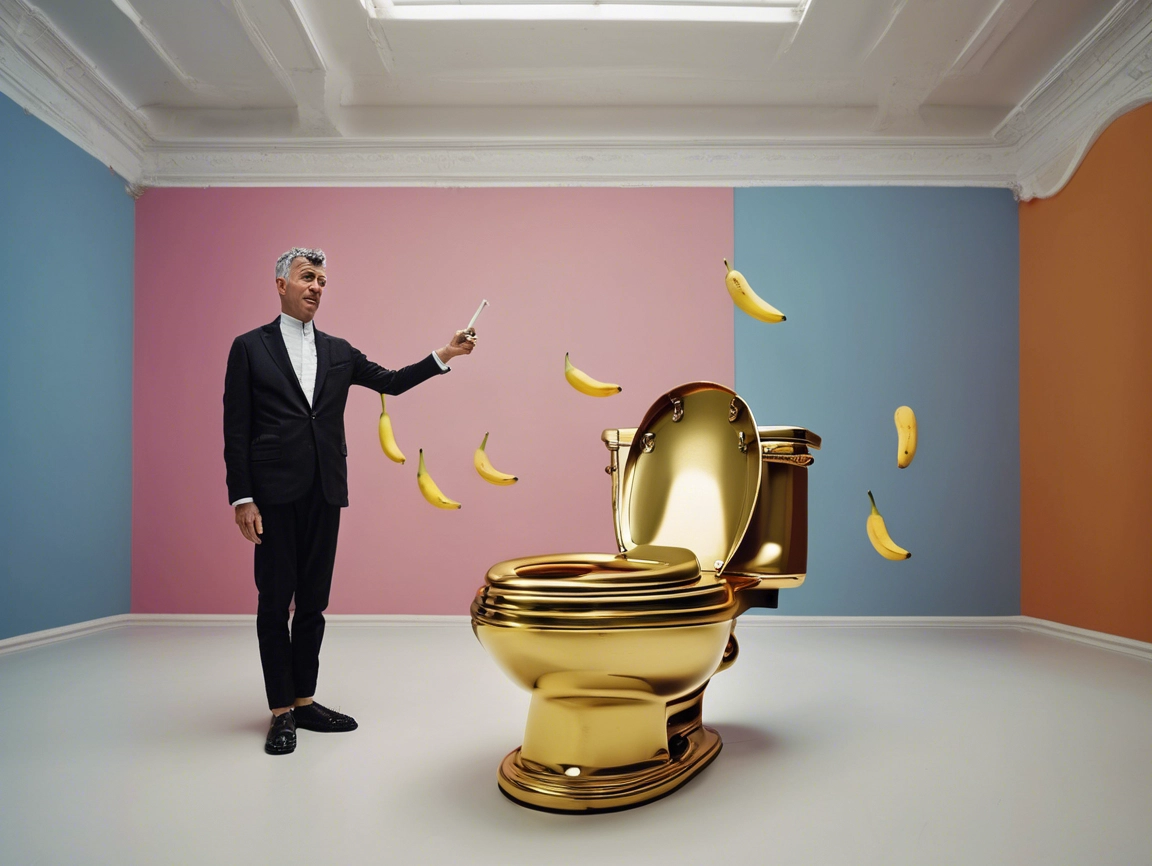
Have you ever wanted to tell someone to get lost in a big way with a big middle finger? Or dream about what a completely golden toilet would be like?
Well, such an eccentric and controversial figure has thought about all this, and we are talking about the Paduan artist Maurizio Cattelan.
The artist was born on September 21, 1960, into a modest family, where he did not follow a traditional academic path but approached art as a self-taught artist. From an early age, he experimented with various materials, developing his own techniques and frequenting art academies that fascinated him, even if he did not attend classes.
This informal approach to art profoundly influenced his style, which is characterized by irreverent irony and the ability to question all types of authority and convention.
During a period when he was devoting himself to furniture design, Cattelan began sending his compositions to major institutions around the world, until he was noticed by a gallery in Bologna: Galleria Neon.
He immediately attracted attention for his ability to transform simple ideas into works that pose profound questions.
His first major success came in the 1990s with the work "Stadium." The work is a long foosball table measuring more than six meters, with the Cesena soccer team reserves playing on one side and Senegalese construction workers playing on the other, under the name A.C. Forniture Sud, referring to the exploited and underpaid labor of migrants from the southern hemisphere.
Despite his success, he has always maintained a rebellious attitude, refusing to adhere to the rules of the traditional art system.
Even when he was accepted at important fairs, such as the Venice Biennale in 1993, he came up with rebellious and bizarre interventions, such as the work "Lavorare è un brutto mestiere" (Working is a bad job), in which an advertising billboard appeared in his exhibition space after he rented the space to an advertising agency.
In the 1990s, he created several works using taxidermy, such as the famous "Novecento" now on display at the Castello di Rivoli, which depicts a horse suspended from the ceiling by a harness, with its neck and legs stretched toward the ground, conveying a deep sense of melancholy and frustration at its inability to move.
Not just art
During his career, he has not only worked on installations and sculptures, but also on projects on a different scale. In 2003, he launched his first magazine, Processed Food, with the help of Paola Manfrin and Dominique Gonzalez-Foerster, where he mixes images, giving them new life in other contexts. This is not the only editorial project he has been involved in: in 2010, together with Italian photographer Pierpaolo Ferrari, known for his colorful surrealism, he created the biannual magazine "Toilet Paper," which quickly became iconic for its provocative and surreal style.
Throughout his career, he has also been involved in curatorial themes for various exhibitions.
The fake farewell to art
In addition to his entertaining and meaningful works, the artist is also a master at promoting himself and generating buzz. In fact, Cattelan is known for the numerous times he has said he is giving up everything to focus on other projects, only to return even more determined than before, with works that leave everyone speechless.
The central themes of Cattelan's poetics
Cattelan's works revolve around universal themes, but are approached with an ironic and provocative language.
Death, religion, power, and the sense of individual failure are at the heart of his work. Cattelan often uses elements with a strong visual impact to create a short circuit between form and content, prompting the viewer to reflect on uncomfortable issues.
One of the distinctive features of his work is the use of unusual materials and everyday objects, which are decontextualized and transformed into works of art. This ability to transform the mundane into the extraordinary is one of the reasons why Cattelan has often been compared to the Dadaists and Pop Art artists.
However, his irony is more cutting and often accompanied by a vein of melancholy.
The most significant works
Among Maurizio Cattelan's best-known works, some have achieved iconic status, becoming symbols of his unique approach to art:
La Nona Ora (1999): This sculpture depicts Pope John Paul II struck by a meteorite, an image that sparked scandal but also admiration for its courage in addressing religious themes in an unconventional way. The work has been interpreted in different ways: some say it refers to the scandals that occurred in the Church at that time, while others see it as a reflection on the weight of suffering and the role of spiritual power.
Him (2001): Perhaps one of Cattelan's most controversial works, this small statue of Adolf Hitler kneeling sparked heated debate. Positioned in such a way that it initially appears to be a child praying, the work plays with the viewer's expectations, inviting them to confront evil and redemption. The work was presented in 2012 at the Warsaw Ghetto, causing outrage.
L.O.V.E.: A giant hand raising its middle finger, with the other four fingers severed, a provocative gesture that challenges conventions and politics, located in Piazza Affari in Milan. The sculpture is about 4 meters high and, while criticizing the dynamics of power and corruption, has also been interpreted as an ironic commentary on contemporary society. The hand is carved from Carrara marble, a material that recalls artistic tradition, but its message is decidedly contemporary and bold.
America (2016): A toilet made entirely of solid gold, installed at the Guggenheim Museum and open to the public for use. The fully functional toilet was stolen in September 2019. The work is a critique of consumerism and capitalism, but also an ironic reflection on the democratization of art.
Comedian: the work that revolutionized the concept of contemporary art
The work that definitively established Cattelan as a master of provocation is Comedian, presented for the first time in 2019 during Art Basel Miami Beach. The work consists of a banana fixed to a wall with gray duct tape. Despite the extreme simplicity of the concept, Comedian has been valued at over $120,000, generating a wave of comments and reactions on social media and in art circles.
The internet has not held back in mocking this situation, creating endless parodies of the work, with subjects ranging from Queen Elizabeth to cinema icons, all featured on the Instagram page @cattelanbanana.
Comedian is not just a provocation, but a reflection on the symbolic value of art. The banana, a common and perishable fruit, becomes a cult object thanks to the context in which it is placed. The work raises fundamental questions about the role of the artist, the meaning of authenticity, and the nature of the art market.
Cattelan said that the idea for the work came to him after reflecting on the need to create something simple and immediate, capable of capturing the public's attention in a direct way.
The recent resale and debate over the value of the work
The story of Comedian did not end with its exhibition in Miami. Recently, on November 20, 2024, the work was put up for auction again by Sotheby's and sold for an exorbitant sum: a whopping $6.24 million.
The winning bid came from Chinese collector and CEO Justin Sun, reigniting the debate on the actual value of such conceptual works. The news sparked renewed interest and controversy, questioning the boundaries between art and commerce.
A particularly interesting aspect is that the banana itself must be replaced periodically, following a protocol established by the artist. This element contributes to making Comedian a living work, one that evolves over time and challenges the concept of permanence in art.
The resale has also raised legal and moral questions: how much is a work worth that can be easily reproduced? And what are the limits of copyright and intellectual property in cases like this?
Maurizio Cattelan remains an essential reference point for anyone who wants to understand the dynamics of contemporary art. With his ability to combine irony, social criticism, and experimentation, he has carved out a unique place for himself on the international art scene. Comedian, with its disarming simplicity, perhaps represents the pinnacle of his poetics, demonstrating that art does not need to be complicated to be powerful.
In an increasingly complex and fragmented world, Cattelan's art reminds us of the importance of looking beyond appearances and critically addressing the contradictions of our age.


Join in!
Comments