In the art world, the image of the solitary artist who shapes every detail of the work with his own hands
is a myth that is as romantic as it is partial. Creative delegation, or entrusting
the execution of the work, or part of it, to assistants, collaborators, or technicians, runs through the
history of art, raising questions about authorship, authenticity, and value.
From the Renaissance to Baroque workshops
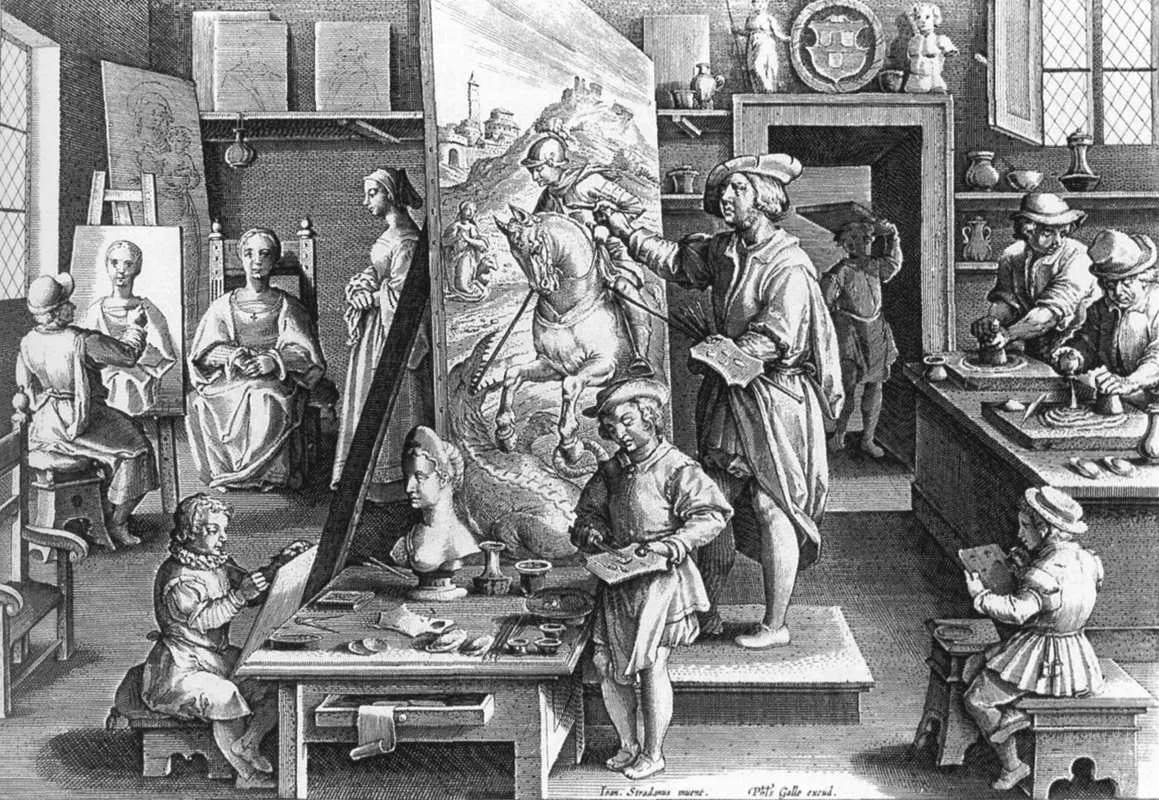
During the Renaissance, delegation was common practice. Large workshops functioned as collective laboratories
where the master conceived the work, but its execution was often entrusted to apprentices or
students. Sandro Botticelli, for example, surrounded himself with assistants who contributed to works attributed
solely to him. The same was true of Titian, who in his later years left large portions of his canvases
to his assistants. The artist conceived, corrected, and refined: the idea remained his, even if the hand sometimes did not.
In his Painting and Experience in Fifteenth Century Italy,
, art critic Michael Baxandall emphasizes that the value of a Renaissance painting was linked more to the "concept" of the work and the
prestige of the master than to the exclusive manual authorship. The work was a collective achievement, but there was only one
name at the bottom.
Canova, Rubens, and the power of drawing
Antonio Canova, the greatest neoclassical sculptor, rarely touched raw marble. He delegated the roughing out of his works to trusted stonemasons
, intervening directly only in the finishing of the surfaces
and in the expressive details. Similarly, Peter Paul Rubens, a prolific painter, made use of a large workshop of painters
who, based on his drawings or sketches, completed the large canvases.
This practice did not cause any scandal. As Giorgio Vasari stated in his Lives, the artist was
first and foremost an "inventor," an "architect of the image," and drawing was what defined the
true authorship of the work.
The conceptual revolution: Duchamp, Warhol, and Hirst
The twentieth century, with conceptualism, took delegation to extremes. Marcel Duchamp declared that
"it is the idea that makes the work," not its execution. His Fountain (1917), a urinal signed "R.
Mutt," subverts the principle of art as manual production. The work is not made, but chosen.
Andy Warhol took the concept to its extreme with his Factory, where dozens of assistants
screen-printed canvases in series, under his supervision. "I don't want to be just an artist. I want to be
a machine," Warhol wrote. Critic Arthur Danto defended him by arguing that true art, in his
case, consisted of intuition, the symbolic system put in place, not physical production.
In the 2000s, Damien Hirst candidly stated that he had never touched many of his
famous spot paintings. "It's irrelevant who holds the brush," he said, drawing the ire of some critics. Julian Spalding, in his Con Art, accused Hirst and associates of "turning art into a brand" in which authenticity is sacrificed to the market.
Contemporary criticism: between provocation and system
Today, creative delegation is often seen as an integral part of the contemporary artistic process
. Curator Claire Bishop speaks of "diffuse authorship" and recognizes that post-Duchampian art
challenges the idea of hand and material, proposing more fluid, sometimes corporate production models
.
However, controversy remains. When American artist Jeff Koons was criticized in 2012
for not making his own polished stainless steel sculptures, he defended himself by arguing that his art is "a complex conceptual project
" that requires specialized engineering and craftsmanship.
But critics such as Robert Hughes have called his work "pompous and vacuous," accusing him of
selling art to luxury.
The case of Maurizio Cattel
s another chapter in the reflection on authorship and delegated authorship. Famous for provocative works such as "Comedian" (a banana attached to the wall with adhesive tape), Cattelan has often relinquished the physical creation of his works, relying on technicians, craftsmen, and installers. The conceptual design is entirely his own, but the construction is the result of
a professional operational chain. In many interviews, the artist has stated: "I don't do anything,
I delegate everything, yet the responsibility is mine." His work thus becomes a gesture, a symbolic action
rather than a physical object.
And, of course, this raises some obvious questions: "Who is the creator of the artwork: the designer
or the person who makes it?" "How much technical expertise is required to define a work of art as such?"
These questions are a major issue for the late 20th and 21st
centuries, and it is not easy to answer them.
Conclusion: idea, hand, delegation
Creative delegation is not an anomaly: it is a constant in the history of art. From Renaissance workshops
to contemporary art multinationals, what changes is the relationship between idea and
realization, between signature and content.
Today, authorship no longer coincides with manual skill, but with intention, system of thought, and aesthetic and cultural device. As German art historian and philosopher Boris Groys wrote: "In the contemporary world, the artist is the author of a message rather than an object." And those who realize it often do not affect its power.
At Artistinct, in line with the trends and artists mentioned above, we are convinced that delegating
the creation of works to artisans and technicians does not diminish the creator,
but rather places them on the same level as a 360° artist, i.e., someone who creates a work of art from
beginning to end in all its phases. Since the 1960s and 1970s, we have increasingly witnessed the conceptualization of art, i.e., the phenomenon whereby emphasis is placed on the concept or idea behind the work of art rather than on its physical or aesthetic form.

Join in!
Comments