
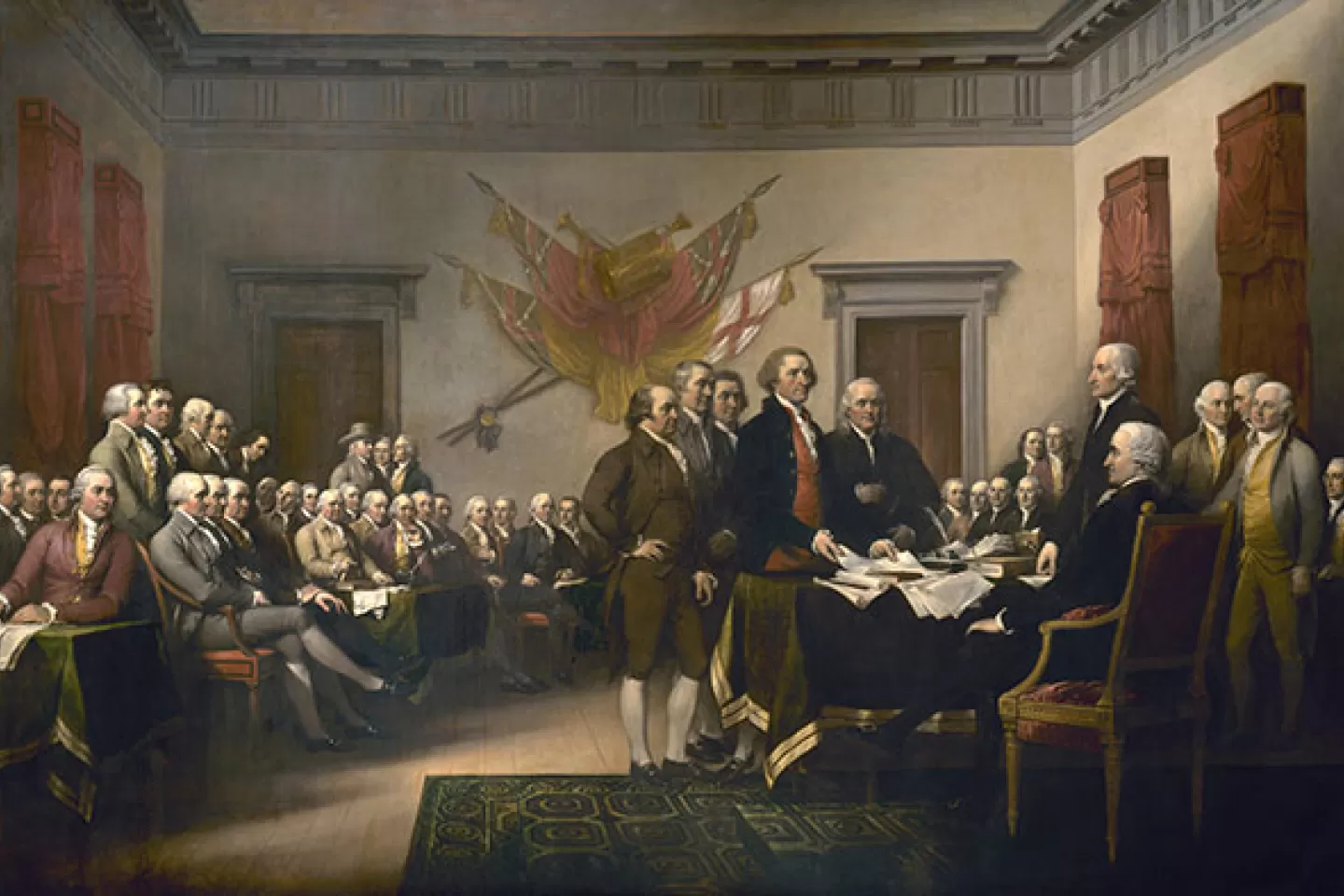
July 4, 1776, was not only the birth of a nation, but the beginning of a search for identity that continues today. As fireworks explode in the American sky, art offers a different lens through which to view America: not that of patriotic parades, but that of unresolved contradictions, broken dreams, and daily battles for freedom. From Emanuel Leutze's Washington Crossing the Delaware to Norman Rockwell's The Problem We All Live With, eight iconic works trace a path from the construction of the national myth to its questioning.
The romantic hero and the birth of the myth
In 1851, Emanuel Leutze painted Washington Crossing the Delaware in Düsseldorf, creating the quintessential romantic image of American birth. Washington, standing tall on the boat amid ice and storm, leads his troops across the frozen Delaware River on Christmas Eve 1776, embodying the hero who defies the elements to conquer freedom. The flag visible in the painting is anachronistic, as it was not yet in use on the night of December 25, 1776; it was only officially adopted in June 1777. The anachronistic presence of the flag,
together with the theatricality of the scene, reveal the intent of the work: to construct a founding myth for a still young nation.
Leutze understands that every country needs its own legendary heroes. His July 4 is that of epic, where history becomes an exemplary tale: America triumphs thanks to its faith and determination, despite every obstacle.
The austere face of the frontier
In 1930, Grant Wood responded to Leutze's romanticism with American Gothic. The pitchfork wielded by the man and the stern gazes of the couple in front of their Carpenter Gothic-style house in Iowa do not celebrate rural life, but reveal the harshness of small communities in the Midwest. Wood does not idealize the pastoral dream: he presents it in its stark reality, made up of sacrifice and moral rigidity, becoming a symbol of American resilience during the Great Depression.
His Fourth of July is not made up of fanfare, but of silent daily resistance.
The loneliness of the metropolis
Edward Hopper, with Nighthawks from 1942, captures the other face of America: urban, modern, but deeply lonely. The work is set in an American city (inspired by New York) during World War II. In the diner lit up at night, four figures are physically close but emotionally distant. The absence of a visible door transforms the space into a glass prison. Hopper captures a fundamental paradox: individual freedom can turn into loneliness and existential alienation. His 4th of July is that of those who celebrate independence only to find themselves terribly alone.
The table of democracy
Rockwell's 1943 Freedom from Want shows America coming together around a table. Part of the "Four Freedoms" series, inspired by Franklin D. Roosevelt's 1941 speech, it shows a family gathered around a table set for Thanksgiving. But here too, beneath the idyllic surface, the scars of war are hidden: the presence of only water on the table alludes to the hardships of wartime. Rockwell shows that American independence is built through sharing and collective sacrifice.
The resilience of the soul
With his 1948 painting Christina's World, American artist Andrew Wyeth offers the most powerful metaphor for independence. Christina, who suffers from a neuromuscular disease, gazes toward a distant house from an empty field. Her physical limitation becomes inner strength. Wyeth paints an America of people who do not give up, who find a form of resistance in their own fragility.
When the flag becomes a question
In 1954-55, Jasper Johns revolutionized the concept of patriotism with Flag. By transforming the flag into an art object, Johns posed a disturbing question: what does it really mean to be American? The material surface transforms the national symbol into something tactile,
human, and questioning. Johns anticipated protest movements, showing that true patriotism can consist in questioning one's own symbols.
From dream to awakening
Andy Warhol, with Marilyn Diptych from 1962, captures the America of the television age, where the American dream has been transformed into spectacle. The fifty silkscreen images of Marilyn Monroe become a meditation on mortality and the commodification of celebrity. Warhol paints an America that has turned its heroes into commodities, its dreams into consumer products.
The courage of a little girl
The final piece is Rockwell's 1964 The Problem We All Live With, which has become an icon of the civil rights movement in the United States. Ruby Bridges, the African American girl escorted by four federal agents to a school previously reserved for whites, embodies the true spirit of July 4: that of those who concretely claim their freedom. Rockwell, who had sung the praises of an idyllic America, here denounces its deepest contradictions.
Independence as a process
These eight works show us that American independence was not an event that ended on July 4, 1776, but an ongoing process. Art has had the courage to tell this complex truth, moving from Leutze's romantic myth to Rockwell's social commentary.
The real Fourth of July is not that of parades, but that of those who know how to face their own contradictions, who find in criticism a form of love, who celebrate independence not as a definitive conquest, but as a daily commitment.

Join in!
Comments