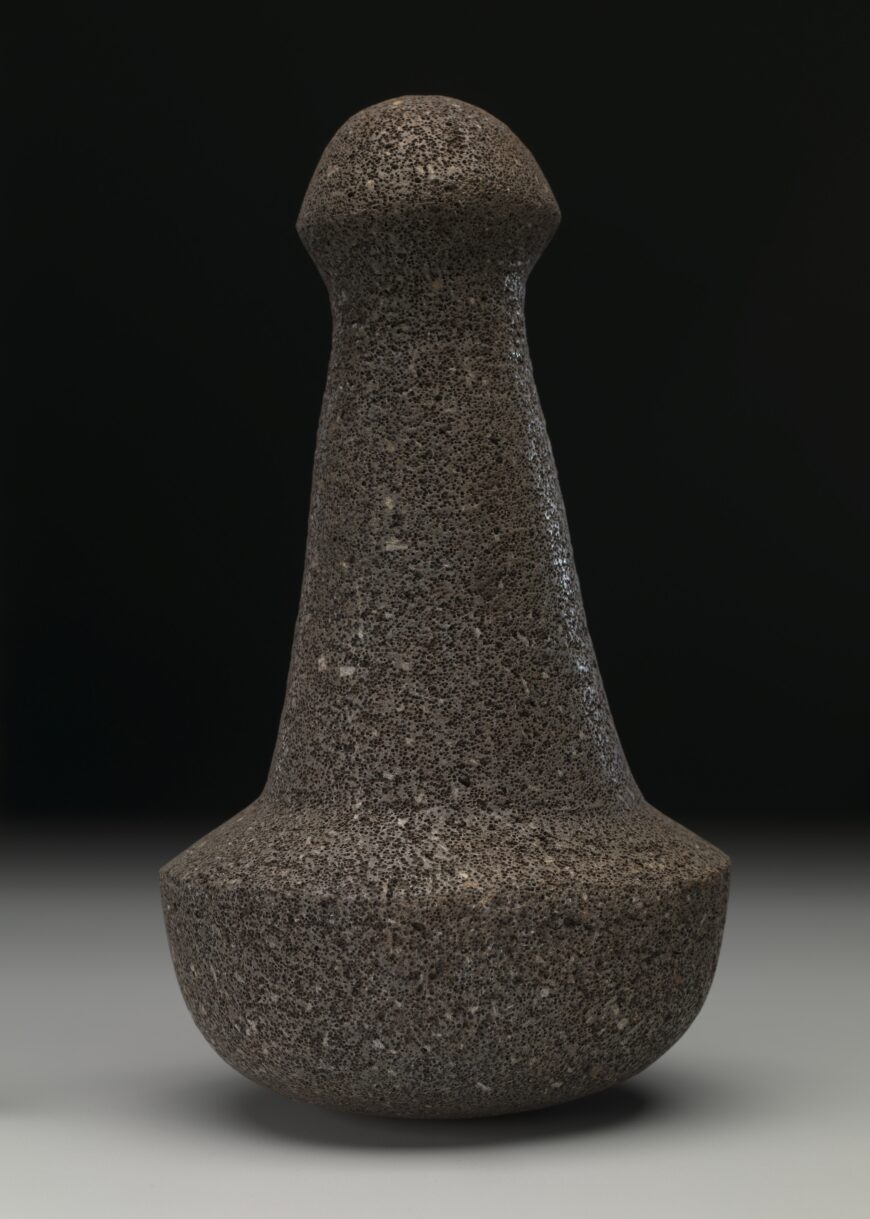
One of the most ubiquitous Hawaiian objects found in museums and private collections worldwide is the humble poi pounder, known in the Hawaiian language as pōhaku kuʻi ʻai or pōhaku kuʻi poi. Ranging in size, color, and texture, they are carved fromʻalā(dense waterworn basalt) found on beaches, streams, and in rivers into elegant utilitarian tools. Paired with a papa kuʻi ʻai (poi-pounding board), the poi pounder is used in pounding kalo (taro,Colocasia esculenta) and other starchy vegetables such as ʻulu (breadfruit,Artocarpus altilis) and ʻuala (sweet potato,Ipomoea batatas) with water into a nutritious sticky paste called poi. Kalo is the primary staple crop of Kanaka ʻŌiwi (Native Hawaiians) and is considered to be a manifestation of Hāloanakalaukapalili, a premature child born to Wākea and Hoʻohōkūkalani whose earthly remains became the first taro plant. Their second child, also named Hāloa, is considered to be the progenitor of Kanaka ʻŌiwi. [2] Thus, kalo is regarded as an ancestor by many. The pōhaku kuʻi ʻai, the primary instrument used in creating poi, is imbued with deep significance for Kanaka ʻŌiwi, representing a classic example of the union of functionality, form, and symbolism in Hawaiian art and design.