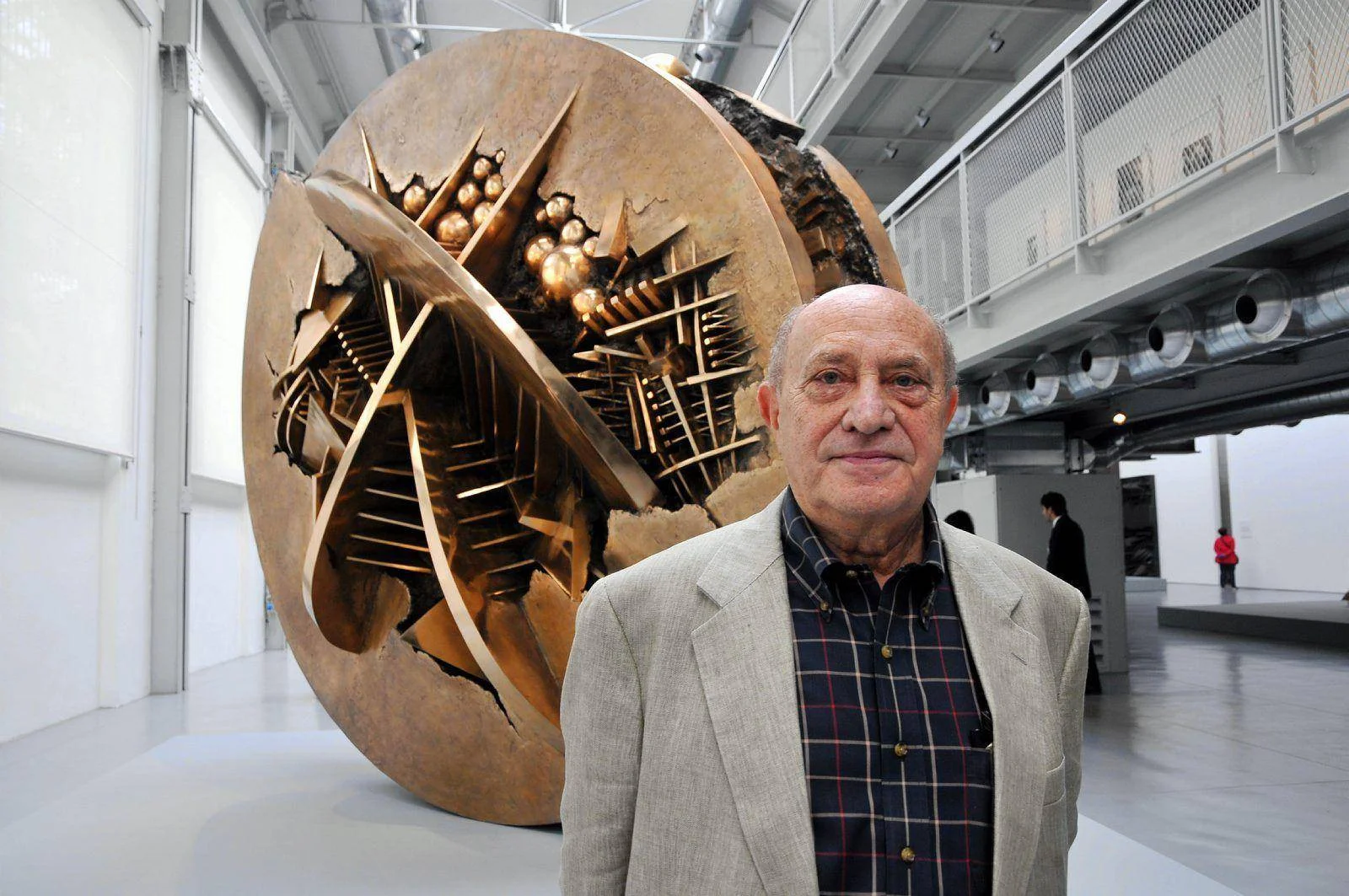
Known primarily for his monumental "Spheres," works that seem to emerge from a mechanical and arcane universe, Pomodoro has constructed a sculptural language capable of transcending eras, places, and sensibilities, becoming a symbol of art that constantly dialogues with man and society.
Born in Morciano di Romagna in 1926, Arnaldo Pomodoro is one of the most famous and influential Italian sculptors of the 20th and 21st centuries. Pomodoro's career took shape in the 1950s, after he moved to Milan, where he came into contact with leading figures of the Italian and international avant-garde. Here he developed an independent poetic style, characterized by an interest in materials, architecture, primordial signs and forms, but also technology and geometry. Starting in 1955, he exhibited with increasing regularity in Italy and abroad, participating in prestigious exhibitions such as the Venice Biennale and Documenta in Kassel.
Between the 1960s and 1970s, Pomodoro consolidated his personal style and devoted himself to creating large bronze sculptures, characterized by a unique combination of geometric shapes and internal openings. Among his best-known works are the series of "
" "Spheres," such as "Sphere with Sphere," exhibited in symbolic locations such as the Cortile della Pigna in the Vatican, the United Nations headquarters in New York, Trinity College in Dublin, and the University of California at Berkeley. But his repertoire is wide and varied: noteworthy examples include the "Colonne" (Columns) and "Obelischi" (Obelisks), such as "Colonna a grandi fogli" (Column with Large Leaves) and "Obelisco per Cleopatra" (Obelisk for Cleopatra), which explore the concept of verticality and monumentality. Also noteworthy are his site-specific works, such as the "Grande Portale" for Cefalù Cathedral and the imposing "Ingresso al Labirinto" at the headquarters of the Arnaldo Pomodoro Foundation in Milan. In all his creations, Pomodoro sought to integrate art with urban space, making sculpture
an immersive experience.
Pomodoro used an abstract but accessible visual language, which allowed a very wide audience to approach his works without necessarily having specific artistic skills. His sculptures are designed to be viewed from all sides, encouraging active participation by the observer. The incisions, openings, and variations in the surface offer different interpretations, arousing curiosity and interest. This approach has enabled his works to establish direct contact with the public, fostering a personal and subjective relationship with each viewer.
His work has been enthusiastically received both nationally and internationally.
His solo exhibitions have been hosted in the world's most important museums, from MoMA in New York (1965) to the Museum of Modern Art in Tokyo (1988). He has received countless awards, including the Gold Medal for Cultural Merit (2005), an honorary degree from Trinity College in Dublin (1992), and the Praemium Imperiale for Sculpture (1990).
Pomodoro's influence on contemporary society is tangible and enduring. His vision of public art that is accessible and integrated into the urban fabric has helped redefine the role of sculpture in the contemporary landscape. He has inspired generations of artists, architects, and designers, inviting them to think of form not merely as aesthetics but as a vehicle for thought. With the Arnaldo Pomodoro Foundation, established in 1995, the artist also promoted art education, the conservation of works, and experimentation with new languages.
Arnaldo Pomodoro is a sculptor who has distinguished himself for his ability to combine technique, reflection, and formal research. His works invite us to reflect on the complexity of the present and the value of memory. In a cultural context that is often fast-paced and superficial, his contribution remains relevant and significant.
We at Artistinct join in the national mourning, and we want to keep alive the memory of a figure who was so important and influential for many decades, to the point of being a source of inspiration and reference. Following in the footsteps of the great sculptor, Artistinct also aims to internationalize, creating an artistic network without barriers or constraints, in order to make art, in all its forms, accessible to everyone.

Join in!
Comments